Filing a joint tax return with your spouse can save you money, but it also comes with big legal risks. When you sign a joint return, the government treats you and your spouse as a single unit. This means both of you are completely responsible for the entire tax bill, including all interest and penalties.
Even if your spouse earned all the money or made all the mistakes, the government can legally demand the entire payment from you. This responsibility does not end if you get a divorce, even if a state court judge orders your ex-spouse to pay the taxes. If you are facing an unfair tax debt, IRS letters can be terrifying.
To prevent couples from facing unfair financial ruin, the government offers a series of programs known as Innocent Spouse Relief. These programs help you separate your taxes from your spouse’s mistakes. Instead of hiring expensive lawyers, you can now resolve these stressful problems using self-help, plug-and-play digital tools like IRS Guys, which guide you through the process step-by-step.
What Is the Problem with Joint Tax Returns?
When you file a joint return, the government views both partners as primary debtors. If there is an error on the return, you both owe the money. This usually happens in one of two ways:
- Understated Tax: This happens when a spouse hides income or claims fake business deductions, making the tax bill look much smaller than it actually is.
- Underpaid Tax: This happens when the tax return is filled out correctly, but the couple fails to send the actual payment to the government.
The difference between these two issues is very important because the program you qualify for depends on which problem you have.
Exploring the Best Innocent Spouse Relief Options for Tax Debt IRS
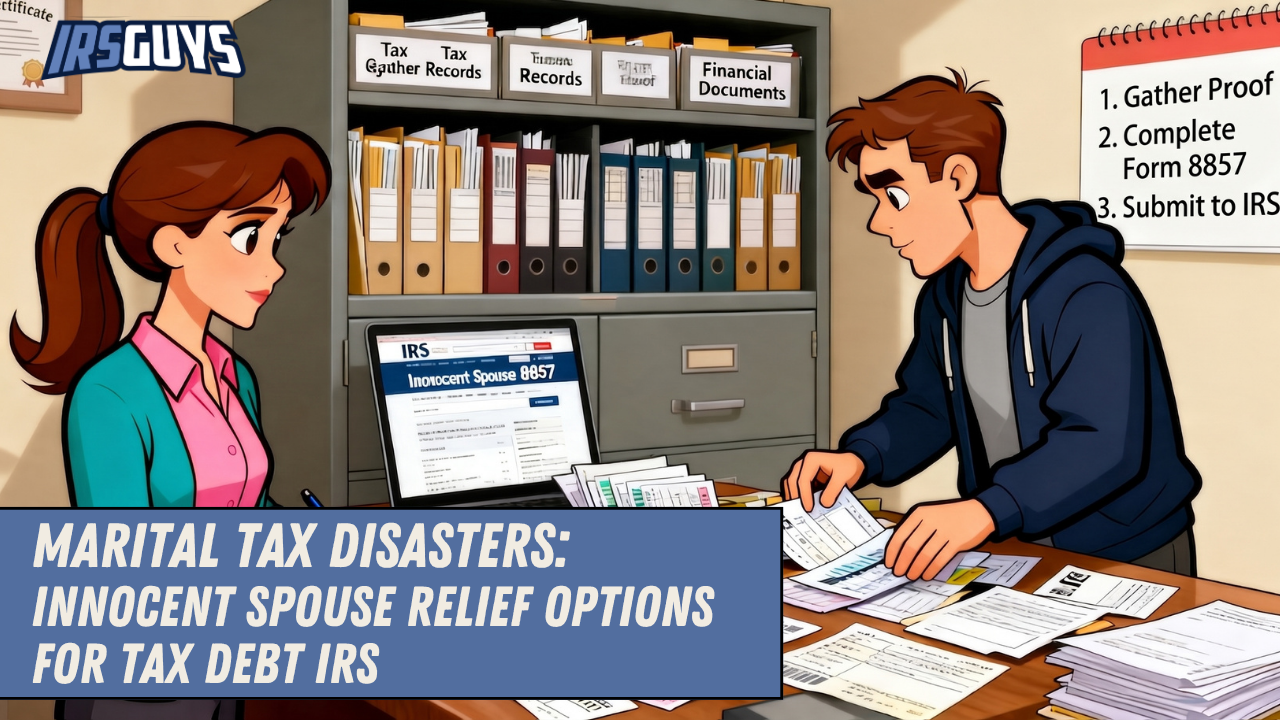
If you believe you should not be held responsible for a joint tax bill, you must submit Form 8857, Request for Innocent Spouse Relief. Once you send this form, the government automatically checks to see if you qualify for three different programs. You do not have to guess which program fits you best, because the government will apply the option that gives you the most help.
The three main types of relief include:
- Classic Innocent Spouse Relief: This option completely wipes away the tax, interest, and penalties. It is best for spouses who had no idea their partner made mistakes on the joint tax return. This option only applies to understated taxes.
- Separation of Liability Relief: This option divides the tax bill between you and your spouse based on who actually earned the income or took the deductions. You become responsible only for your individual share. It is only for people who are divorced, legally separated, widowed, or have lived apart for at least 12 months. It only applies to understated taxes.
- Equitable Relief: This is a safety net when you do not qualify for the other two options, but it would still be unfair to bear responsibility based on all the facts. Unlike the other options, this can help you if the tax bill was correct, but your spouse simply did not pay it.
How Does Classic Innocent Spouse Relief Work?
Classic Innocent Spouse Relief provides full forgiveness of a tax debt if the errors were entirely your partner’s fault. If you qualify, you will not have to pay any portion of the tax, interest, or penalties.
To get this relief, you must prove that when you signed the return, you did not know, and had no reason to know, that the tax was understated. The government will look at whether a reasonable person in your situation would have noticed red flags on the tax return. They will evaluate your level of education, how involved you were in family business matters, and whether you made any sudden, lavish purchases that would suggest hidden income. If you knew about a portion of the errors, you can still get partial relief for the part you genuinely did not know about.
Who Qualifies for Separation of Liability Relief?
Separation of Liability Relief acts like a financial scalpel, dividing the joint tax debt. Instead of wiping the entire debt away, the government recalculates the bill and holds you responsible only for your own income and deductions. For example, if your self-employed spouse hid income while you reported your wages correctly, you would only be responsible for the taxes on your own wages.
To qualify, you must be divorced, legally separated, widowed, or you must have lived completely apart from your spouse for the entire 12-month period before you file Form 8857. Unlike the classic program, the burden of proof is on the government to show that you had actual knowledge of the errors. If they cannot prove you actually knew about the errors, your relief will be approved. However, this program only applies to unpaid tax balances and cannot be used to get a refund for taxes you already paid.
When Does the IRS Grant Equitable Relief?
Equitable Relief serves as a legal safety net. It is the only program that can help you if your spouse failed to pay the correct tax bill. To qualify, you must show that holding you responsible for the debt would be highly unfair.
The government evaluates these cases using guidelines found in Revenue Procedure 2013-34. They first check for a fast, “streamlined” approval, which is granted if you are no longer married, would face severe financial hardship, and did not know about the tax problem. If you do not meet the streamlined rules, the government balances seven factors to make a decision:
- Marital Status: Being divorced, separated, or widowed helps your case, while remaining married is neutral.
- Economic Hardship: You must show that paying the tax bill would prevent you from paying for basic needs, like food, rent, or medicine.
- Knowledge: The government looks at whether you knew about the errors or reasonably expected your spouse to pay the bill.
- Legal Obligation: If your divorce decree states that your former spouse must pay the tax debt, this helps your case.
- Significant Benefit: The government checks if you received lavish benefits, such as luxury cars or expensive vacations, from the unpaid tax money.
- Tax Compliance: The government looks at whether you have filed and paid your taxes on time in the years after the mistake occurred.
- Mental or Physical Health: Poor health at the time you filed the return or when you request relief will help your case.
How Does Spousal Abuse and Financial Control Affect a Case?
One of the most important rules is how the government handles domestic violence and coercive financial control. Under the rules, the government recognizes that abuse can prevent a spouse from questioning a tax return or refusing to sign it out of fear.
If you can show you were a victim of physical, emotional, or financial abuse before signing the return, the government may decide you signed under pressure. This makes the joint return invalid, meaning you are only responsible for your own separate income. Furthermore, if abuse is present, it negates negative factors like “knowledge” or “significant benefit”. The government will weigh the presence of abuse heavily in your favor, even if you technically knew about the errors.
How Do Innocent Spouse and Injured Spouse Relief Programs Differ?
Taxpayers often confuse Innocent Spouse Relief with Injured Spouse Relief. While both deal with marital tax issues, they apply to completely different situations and use different forms.
Innocent Spouse Relief (Form 8857)
- The Goal: To get out of paying a joint tax bill, interest, or penalties that you did not cause.
- The Form: You must file Form 8857.
- The Debt Type: Unpaid or incorrect joint income taxes.
- The Trigger: You receive an audit notice or collection letter from the government.
- The Processing Time: It usually takes 5 to 6 months to get a final decision.
Injured Spouse Relief (Form 8379)
- The Goal: To get back your share of a joint tax refund that the government took to pay your spouse’s separate, past-due debts.
- The Form: You must file Form 8379.
- The Debt Type: Separate debts that belong only to your spouse, such as student loans, child support, or old individual taxes.
- The Trigger: The government automatically takes your joint refund to cover those debts.
- The Processing Time: It usually takes 8 to 14 weeks to process.
What Are the Deadlines and Rules for Filing?
Filing for relief requires following strict rules and deadlines.
To apply, you must mail the completed Form 8857 to the IRS. If you are using the U.S. Postal Service, mail it to: Internal Revenue Service, P.O. Box 120053, Covington, KY 41012. If you are using a private delivery service, mail it to: Internal Revenue Service, 7940 Kentucky Drive, Stop 840F, Covington, KY 41015.
For Classic Innocent Spouse Relief and Separation of Liability Relief, you must file Form 8857 within two years of the first time the government tried to collect the tax from you. Collection actions include wage garnishments or tax liens. Equitable Relief is much more flexible and can be filed at any point during the government’s 10-year collection period.
By law, the government must contact your spouse or former spouse to notify them of your request and allow them to participate. There are no exceptions to this rule, even for victims of abuse. However, the government protects your privacy by keeping your current address, telephone number, and employer completely confidential.
Please note that you are completely ineligible for spousal relief if you have already signed an Offer in Compromise, signed a formal closing agreement covering the same taxes, or if a court has already denied your request. You are also disqualified if you and your spouse transferred property to each other as part of a sketchy scheme to avoid paying taxes.
How IRS Guys Can Help With Resolving Tax Debt
Filing for spousal tax relief is a detailed process that requires presenting clear financial evidence. Mistakes on Form 8857, such as giving conflicting financial information or missing key deadlines, can result in a denial from the government. If your request is denied, you only have 30 days to appeal to the independent Office of Appeals, and 90 days from a final decision to go to the U.S. Tax Court.
Because hiring a personal tax lawyer is often too expensive, taxpayers can turn to automated, plug-and-play digital platforms. Using a plug-and-play digital tool is the easiest way to handle a tax debt.
A self-help tool like IRS Guys provides a step-by-step, interactive system that guides you through the tax debt resolution process.
Don’t want to miss the launch of IRS GUYS?
BOOKMARK THIS PAGE NOW