Key Takeaways
- Unpaid taxes do not show up on your credit report: The IRS does not report tax balances or payment plans to Equifax, Experian, or TransUnion. Credit bureaus also stopped listing tax liens on credit reports in 2018.
- Taking out a personal loan creates a new credit account: Applying triggers a brief hard inquiry dip, but regular, on-time loan payments can steadily boost your credit score over time.
- Installment loans protect your credit utilization: Unlike paying your taxes with a credit card—which spikes your revolving credit utilization and dings your score—a personal loan is installment debt and doesn’t hurt your credit card ratio.
- Missed payment risks are much higher with a bank: If you miss a loan payment by 30 days, the lender reports it, which can severely damage your credit. Missing an IRS payment plan notice does not appear on your credit report.
- Compare the interest rates first: An IRS installment plan typically costs around 10% annually (7% interest plus 0.25% per month failure-to-pay penalty). If your credit score qualifies you for a personal loan well below 10%, borrowing can save you money; otherwise, an IRS payment plan is usually cheaper.
When Uncle Sam Sends an Unwelcome Surprise
Few things in life induce an immediate stomach drop quite like opening a piece of official mail and discovering you owe the Internal Revenue Service a hefty sum of money. Your immediate gut reaction might be to panic, raid the couch cushions, or find the quickest way to make Uncle Sam go away forever.
Naturally, the idea of getting a personal loan pops up. You borrow the cash, wire it to the government, wipe your hands clean, and breathe easy. Crisis averted, right?
Well, not so fast. While trading a debt with the federal government for a debt with an online lender or local bank sounds straightforward, it changes how your finances look to the credit bureaus. Before you rush to take out a loan to settle your tax bill, let’s unpack how this swap actually impacts your credit score, what the IRS secretly doesn’t care about, and how to make the smartest financial play.
The Big Surprise: The IRS Doesn’t Report to Credit Bureaus
Here is the biggest myth in personal finance: many people assume that having back taxes automatically ruins their credit score.
In reality, the IRS does not report unpaid taxes, late notices, or approved payment agreements to Equifax, Experian, or TransUnion. If you owe $5,000 or $25,000 on your federal tax return, that balance remains invisible on standard credit scoring models like FICO and VantageScore.
What about tax liens? Years ago, if you owed a substantial amount, the IRS could file a public Notice of Federal Tax Lien, which credit bureaus would pick up, causing credit scores to plummet. However, following consumer reporting reforms known as the National Consumer Assistance Plan (NCAP), the three major credit bureaus permanently removed all tax liens from credit reports in 2018.
That means an outstanding balance with the IRS does not lower your credit score. But when you borrow money from a commercial lender to pay that bill, you are voluntarily moving an invisible debt into the credit reporting spotlight.
What Happens to Your Credit Score When You Take Out a Personal Loan?
Taking out a personal loan isn’t inherently bad for your credit—in fact, it often helps over the long term. Here is the step-by-step breakdown of what happens to your score when you finance your tax bill:
1. The Short-Term Application Dip
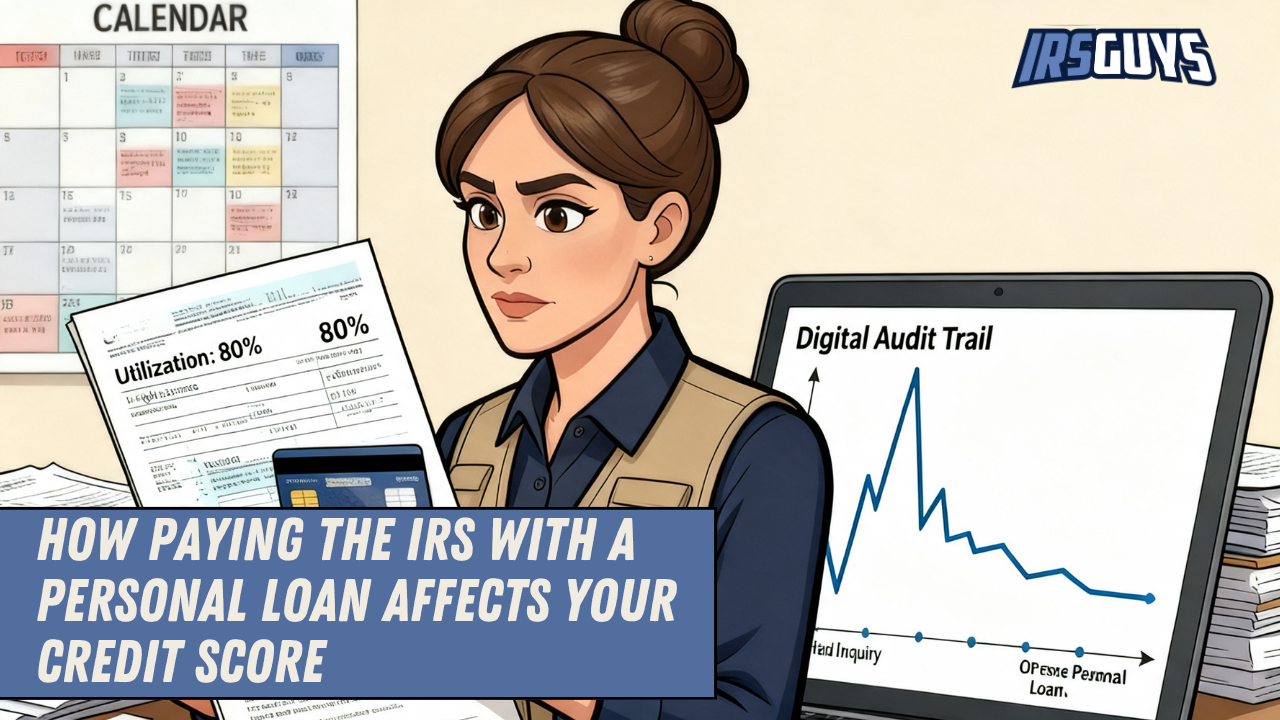
When you formally apply for a personal loan, the lender conducts a deep inquiry on your credit report. This hard inquiry typically trims a few points from your score and remains on your record for up to 24 months (though it generally only affects your score for 12 months). Opening a brand-new loan also cuts the average age of your credit accounts, which can result in a small, temporary pause in score growth.
2. The Credit Mix Bonus
Credit scoring models like seeing that you can handle different types of debt responsibly. If your credit profile consists mostly of revolving credit cards, introducing a fixed installment loan diversifies your portfolio. This healthy mix can give your score a modest upward nudge that helps balance out the hard inquiry.
3. No Damage to Your Credit Card Utilization
Your credit utilization ratio (how much of your credit card limit you are using) is one of the most important components of your credit score.
- If you pay your taxes using an existing credit card, you can easily max out your card limit. Crossing 30% utilization can rapidly drag down your credit score. Plus, third-party processors charge fees of 1.75% to 1.85% just to process the transaction.
- In contrast, a personal loan is closed-end installment debt. It does not count toward your credit card utilization ratio. A $10,000 personal loan won’t make you look maxed out on revolving credit.
4. The Long-Term Boost: On-Time Payments
Payment history accounts for about 35% of your FICO score. Every month you make an on-time payment on your personal loan, the lender reports that positive track record to the credit bureaus. Over a two- to five-year term, consistently paying down that balance can build a stronger credit foundation.
The Hidden Catch: Commercial Risk vs. Government Flexibility
The biggest catch of paying off the IRS with a personal loan comes down to what happens if life throws a curveball and you can’t pay.
- Defaulting on a Personal Loan: Commercial lenders don’t wait around. If an unexpected job loss or medical emergency causes you to miss a personal loan payment by 30 days or more, the lender reports the delinquency directly to credit bureaus. A single 30-day late payment can slash 60 to 100 points off an otherwise excellent credit score, and that mark stays on your report for up to seven years.
- Defaulting on an IRS Payment Plan: If you fall behind on an IRS payment plan, you will receive administrative notices (such as a CP 523 letter) warning you that your agreement is in jeopardy. The IRS has strict collection powers, including the ability to levy bank accounts or seize assets if ignored. However, those administrative actions do not generate derogatory tradelines on your consumer credit report. Furthermore, the IRS allows you to revise your payment agreement online for a modest $6 fee or request temporary hardship status if you hit hard times.
Trading an IRS debt for a private personal loan swaps flexible administrative collection for rigid, credit-damaging bureau reporting.
Doing the Math: IRS Payment Plans vs. Personal Loan Rates
Before borrowing, you should compare the actual cost of keeping the balance with the IRS against the annual percentage rate (APR) of a bank loan:
What the IRS Charges
Carrying an unpaid balance on an approved installment agreement involves two main statutory components:
- Interest: Set quarterly by federal law (tied to the federal short-term rate plus 3 percentage points). The current rate is 7.00% per year, compounded daily.
- Failure-to-Pay Penalty: While a standard late penalty is 0.50% per month, entering an approved IRS payment plan cuts that penalty in half to 0.25% per month (equal to 3.00% simple interest per year).
- Total Combined IRS Cost: Roughly 10.00% to 10.25% annually.
- Setup Fees: Establishing a Direct Debit Installment Agreement online costs just $29 (which is completely waived for qualifying low-income taxpayers). If you only need up to 180 days to pay, a short-term plan has a $0 setup fee.
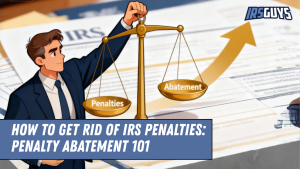
Bonus Tip: If you have filed and paid your taxes cleanly for the past three years, you may qualify for the IRS First-Time Penalty Abatement program. This administrative waiver completely wipes out the failure-to-pay penalties, dropping your borrowing cost to just the baseline 7.00% interest rate!
What Personal Loans Charge
Personal loan rates depend on your credit score:
- Excellent Credit (740+): Rates often range between 7% and 11% APR, sometimes with low or no origination fees.
- Good to Fair Credit (640–739): Rates typically hover between 12% and 20% APR.
- Below Average Credit (<640): Rates frequently climb between 22% and 36% APR, often accompanied by upfront origination fees of 3% to 8%.
When Should You Use a Personal Loan to Pay the IRS?
Financing your tax bill with a private loan isn’t a one-size-fits-all answer. Here is how to decide:
A Personal Loan Makes Sense If:
- You Have Excellent Credit: If your strong score qualifies you for an unsecured loan with an APR well below 10%, you will save on interest compared to the standard combined IRS rate.
- You Owe More Than $50,000: While standard credit reports ignore tax debt, large liabilities over $50,000 make it much more likely the IRS will file a public Notice of Federal Tax Lien in county property records. If you are an executive, general contractor seeking surety bonds, or business owner relying on commercial lines of credit, a public lien filing can harm your business. Wiping out the balance with a private loan prevents public filings entirely.
- You Need to Protect Passport Travel: Taxpayers with “seriously delinquent tax debt” exceeding $66,000 can face passport restrictions or denials by the State Department. A private loan resolves the balance immediately without waiting on administrative decertification backlogs.
Sticking with an IRS Payment Plan Makes Sense If:
- Your Credit Score is Average or Rebuilding: If personal loan offers carry double-digit interest rates (14% or more), sticking with the IRS’s ~10% rate is much cheaper.
- You Qualify for Penalty Relief: If you have a clean three-year history and can apply for First-Time Penalty Abatement, your effective IRS interest drops to 7.00% (a rate hard to beat in the unsecured private market).
- Your Cash Flow Is Unpredictable: If you run a freelance business or work in an industry with seasonal income, the IRS gives you room to breathe. Missing an IRS payment plan deadline won’t trash your consumer credit score overnight, while a missed bank loan payment definitely will.
The Final Word
Paying off the IRS with a personal loan does not “save” your credit score from an unpaid tax bill, because the tax bill was never on your credit report in the first place.
Instead, a personal loan should be viewed as a financial trade: you are trading the IRS’s administrative rules and 10% statutory rate for a structured bank loan that reports to the credit bureaus each month. If you have pristine credit and can lock in a single-digit APR, taking out a loan can save you money and build positive payment history. But if borrowing costs you more than 10%, signing up for an IRS direct debit plan remains one of the simplest, safest, and most budget-friendly ways to get back in the clear.
Looking for an Easier Way Out of Tax Debt? Meet IRS Guys
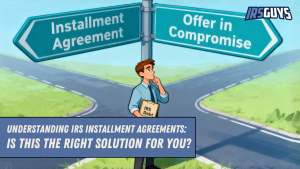
Sorting out your options with the IRS shouldn’t require a law degree, an iron stomach, or hours spent listening to smooth-jazz hold music. Deciding whether you should apply for an Offer in Compromise (OIC), ask for penalty relief, or set up a monthly payment plan can feel like navigating a maze blindfolded.
That’s why we’re building IRS Guys—a platform of smart, “plug-and-play” tax resolution tools designed to take the guesswork out of back taxes.
While the automated platform is still in the workshop, the mission is simple: to give you clear, self-guided tools that analyze your exact situation in minutes. We cut through the bureaucratic red tape to show you the best, most cost-effective path forward so you can resolve your IRS debt with total confidence.
Bookmark this page today so you don’t miss our launch!