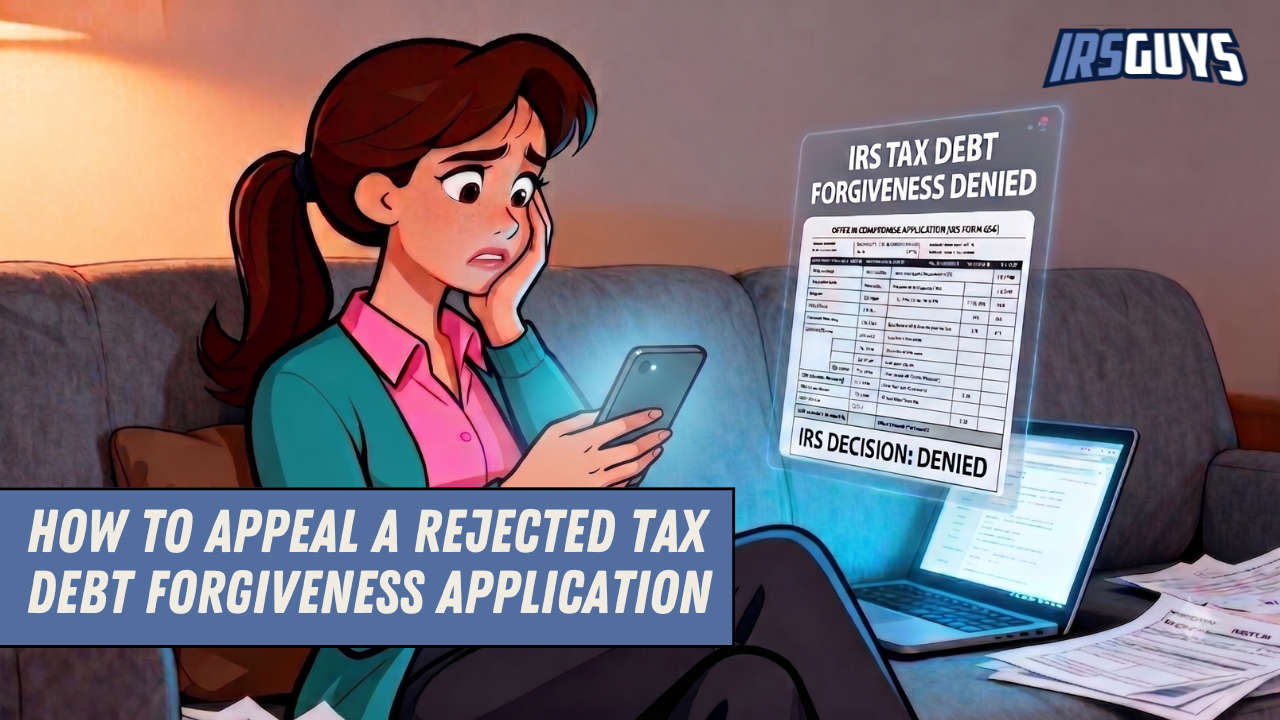
Many individuals, business owners, and self-employed professionals struggle with unpaid tax bills from the IRS. When looking for help, the most common route is submitting an Offer in Compromise, which serves as a formal tax debt forgiveness application. This program allows you to legally settle your tax debt with the government for less than the full amount you owe. Unfortunately, the IRS rejects a massive percentage of these requests. Getting a denial letter can feel like a major setback, but it does not mean your journey is over. You have a legal right to challenge the decision. Knowing how to appeal a rejected tax debt forgiveness application is the key to turning a denial into an approved settlement.
Traditionally, taxpayers had to pay expensive tax professionals thousands of dollars to handle these appeals. Today, you can use modern, self-service software instead. IRS Guys is a plug-and-play tool that individuals, business owners, and self-employed professionals can use to resolve their own tax problems legally. IRS Guys does not offer person-to-person services or consulting. Instead, our automated, plug-and-play platform walks you through the exact steps and forms required to settle your tax debts.
Why Was Your Tax Debt Forgiveness Application Rejected?
Before you start your appeal, you must find out exactly why your tax debt forgiveness application was denied. The IRS separates applications into two different categories: returned and rejected. It is very important to know which one you received, because only a rejected application can be appealed.
A returned application is due to procedural or basic filing errors. This happens if you have unfiled tax returns, are in an active bankruptcy case, forgot to pay the application fee, or did not respond to an IRS agent within 14 days. The IRS does not formally evaluate a returned application, so you cannot appeal it. Instead, you must fix the specific compliance problem and resubmit your paperwork.
A rejected application means the IRS reviewed your entire financial situation and decided your settlement offer was too low. The IRS calculates your “Reasonable Collection Potential,” which is what they think you can realistically afford to pay based on your income and assets. If they think you can pay more than your offer, they will reject your tax debt forgiveness application. You have the legal right to appeal a rejected application.
Filing the Appeal for a Rejected Tax Debt Forgiveness Application
If the IRS officially rejects your offer, you must act quickly. You have a strict 30-day window from the date printed on your rejection letter—usually Letter 656-C—to request an appeal. If you miss this 30-day deadline, the rejection becomes final, and you lose your right to appeal.
To start the process, you must mail your request directly to the specific IRS office that sent you the rejection letter. You can do this by filling out IRS Form 13711, which is the official Request for Appeal of Offer in Compromise. Alternatively, you can write a formal protest letter.
Whichever option you choose, your appeal must include:
- Your full name, current address, Tax Identification Number, and daytime phone number.
- An explicit statement showing that you want to appeal the decision to the Independent Office of Appeals.
- A copy of your official rejection letter.
- The specific tax periods or tax years involved.
- A list of the specific calculations or items you disagree with and a clear statement of why you disagree with each.
- Supporting facts, documents, and any tax laws that help prove your case.
- Your signature at the bottom, signed under penalties of perjury to certify that all statements are true and correct.
If you are appealing on behalf of a business, you must also provide updated business financials and submit an updated Form 433-B alongside Form 13711.
Finding IRS Mistakes in Your Financial Calculations
The IRS sends two worksheets along with your rejection letter: the Income/Expense Table and the Asset/Equity Table. To build a strong appeal, you must compare these worksheets against the original financial statements you submitted. For individuals, this means checking Form 433-A, and for businesses, this means checking Form 433-B.
First, check your monthly household expenses. The IRS uses national and local standards to work out what a household should spend on food, clothing, housing, and transportation. If the IRS allowed less than these standards on their worksheets, or if your actual monthly costs are higher due to special circumstances like chronic medical bills, you have grounds to appeal. You can prove your actual expenses by providing pay stubs, bank statements, lease agreements, or utility bills.
Second, review your asset valuations. The IRS frequently overestimates the value of personal property like cars or real estate. To appeal an overvalued asset, you must provide proof of its real market value, such as a local home appraisal, photographs of damage, or vehicle repair estimates. The IRS calculates the value of your assets using a quick sale value. The standard equation is:
Quick Sale Value = Fair Market Value x 0.8
You can subtract your remaining loan balance from this quick sale value to find your actual net equity. Provide loan payoff statements to prove what you still owe. If the IRS worksheets list higher values than what you actually have, you have a strong reason to dispute their math.
What Happens During the IRS Appeal Process?
Once you submit your appeal, your case is assigned to an independent Appeals Officer who was not involved in the original rejection. This officer will review your arguments and evidence impartially.
While your appeal is being reviewed, the IRS generally pauses all active collection actions. This means they will not attempt to garnish your wages or levy your bank accounts. However, the IRS may still file a federal tax lien to secure the government’s interest in your property.
Keep in mind that you must remain completely compliant with all tax laws while your appeal is pending. This means you must file all required tax returns on time and make necessary estimated tax payments. If you fall behind on new tax obligations, the IRS will immediately deny your appeal.
Resolve Your Tax Debt Legally with Plug-and-Play Software
Navigating an IRS appeal does not have to be expensive. Hiring a CPA or tax attorney to represent you can cost anywhere from $3,000 to $5,000.
With self-service, plug-and-play tax resolution software, you can take control of your tax debt forgiveness application appeal on your own.
We are building IRS Guys to help you bypass high professional fees, helping you accurately state your true financial situation and submit a precise appeal directly to the IRS.
BOOKMARK THIS PAGE SO YOU DON’T MISS THE LAUNCH