
When facing tax debt, arranging an Installment Agreement (IA) with the Internal Revenue Service (IRS) is often the first major step toward financial resolution. However, what happens when new tax debt accrues while you are already paying off old liabilities? Can you simply set up a second payment plan?
For U.S. taxpayers managing debt from multiple years or different income streams, understanding the rules governing multiple agreements is crucial. The short answer is complex: the IRS generally says no to two agreements, but there is one critical structural exception where two plans are mandatory.
The General Rule
The IRS maintains a strong administrative preference for simplicity, enforcing what can be called the “Rule of One.” For an individual taxpayer, the agency generally prohibits maintaining more than one active Installment Agreement at the same time.
If you incur a new tax liability (such as an unpaid balance from a subsequently filed Form 1040) while you are already on a payment plan, the IRS does not want to create a second agreement. Instead, you are required to consolidate the new unpaid balance into the existing arrangement.
This mandate for consolidation is strict because an active IA is a contract of continuous future compliance. If you fail to pay a new tax liability at the time it arises, you have violated the core terms of your existing plan.
The consequence of this violation is severe: the IRS can terminate (default) your original agreement. This termination immediately exposes your entire historical tax debt (the original amount, plus the new debt) to aggressive collection actions, such as bank levies or wage garnishments. To prevent this, you must promptly contact the IRS, recalculate your total consolidated debt, and adjust your monthly payment accordingly.
Individual Payment Options
Most personal income tax liabilities (Form 1040 debt) fall into one of two categories for repayment:
- Streamlined Installment Agreements (SIA): This plan allows you to start your “Tax Debt Restart” if you owe $50,000 or less. You get six years to pay the full amount, and because the debt is under the limit, the IRS approves it quickly, letting you avoid detailed financial disclosure.
- Partial Payment Installment Agreements (PPIA): This is the solution for taxpayers who cannot afford to pay their entire consolidated debt before the Collection Statute Expiration Date (typically 10 years from assessment). Under a PPIA, you pay the maximum you can afford based on your discretionary income until the CSED expires, and the remaining balance becomes uncollectible. This path is complex, however, and requires submitting a detailed financial statement (Form 433-A or 433-F).
In both the Streamlined and Partial Payment scenarios, the core principle remains: all personal income tax debt is consolidated into a single payment administered under a single agreement.
The Critical Exception: Business and Personal Debt
The single, crucial exception to the “Rule of One” occurs when a taxpayer is dealing with two fundamentally different types of federal debt:
- Personal Income Tax Debt: Tracked under the Individual Master File (IMF) using your Social Security Number (SSN).
- Business Employment Tax Debt: Tracked under the Business Master File (BMF) using the Employer Identification Number (EIN).
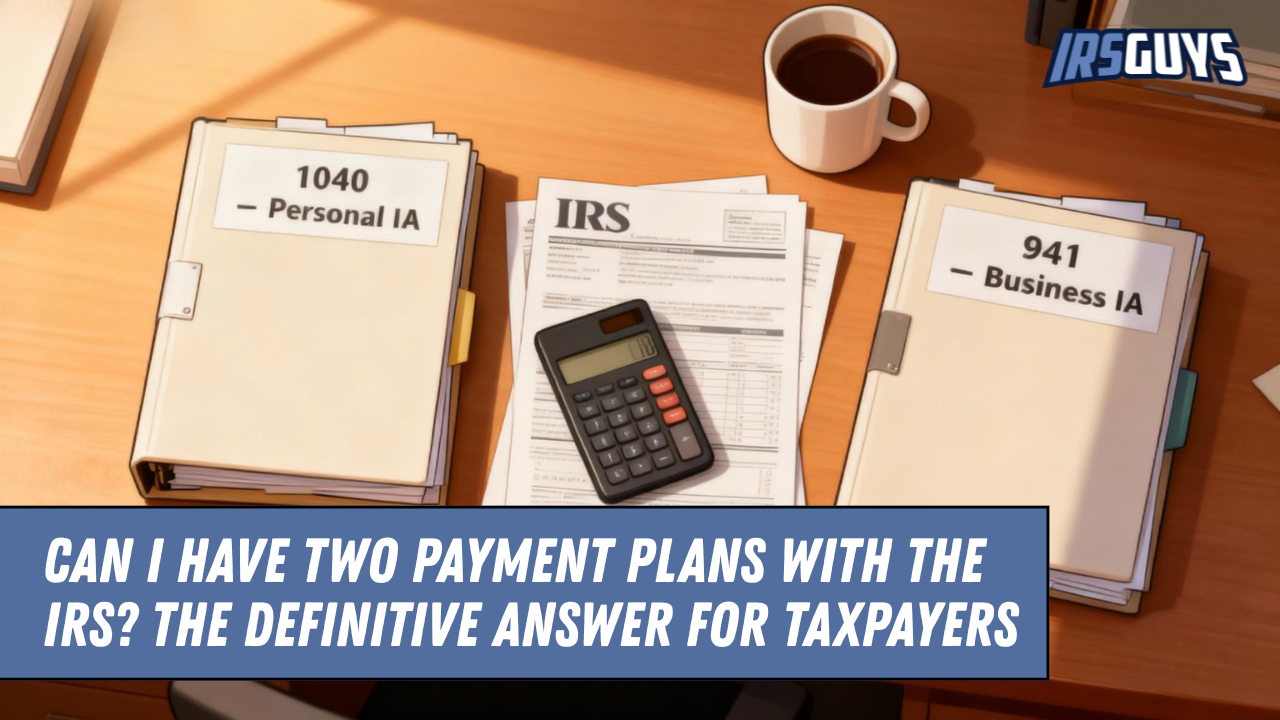
IRS policy dictates that unpaid employment tax liabilities (such as those stemming from Form 941 payroll taxes) cannot be combined in a single Installment Agreement with an individual’s personal income tax debt.
This structural separation means a business owner who owes both types of tax is not only allowed but is required to establish two distinct, concurrent payment arrangements.
The In-Business Trust Fund Express IA
For the business debt, the owner may seek an In-Business Trust Fund Express Installment Agreement (IBTF-Express IA). This plan is specifically for small businesses that are currently operating and owe trust fund taxes.
To qualify for this second, simultaneous plan, the business must meet shorter, stricter terms:
- The business must owe $25,000 or less in assessed liabilities.
- The debt must be fully paid within two years (24 months).
- The business must be current on all future filing and deposit requirements.
In this specific scenario, a business owner can successfully maintain an IBTF-Express IA for their company’s BMF debt while simultaneously holding a separate Streamlined or Non-Streamlined IA for their personal IMF debt.
Bottom Line: Continuous Compliance is Essential
Your key priority during any payment plan is continuous compliance. The IRS keeps adding interest and penalties to the full balance until it reaches zero. To keep your resolution affordable, you must meet all current and future tax payment deadlines.
To avoid a devastating default, ensure you meet the terms of your agreement, which requires filing all subsequent tax returns on time and paying all new tax liabilities in full when they are due. If you anticipate trouble meeting these conditions, contact the IRS or a tax professional immediately to modify the arrangement before the IRS detects the non-compliance and terminates your agreement.