Getting an IRS notice or letter often means you’ll face both civil and possibly criminal penalties. The most important factor the IRS looks at is willfulness, whether you made an honest mistake or knowingly broke the law.
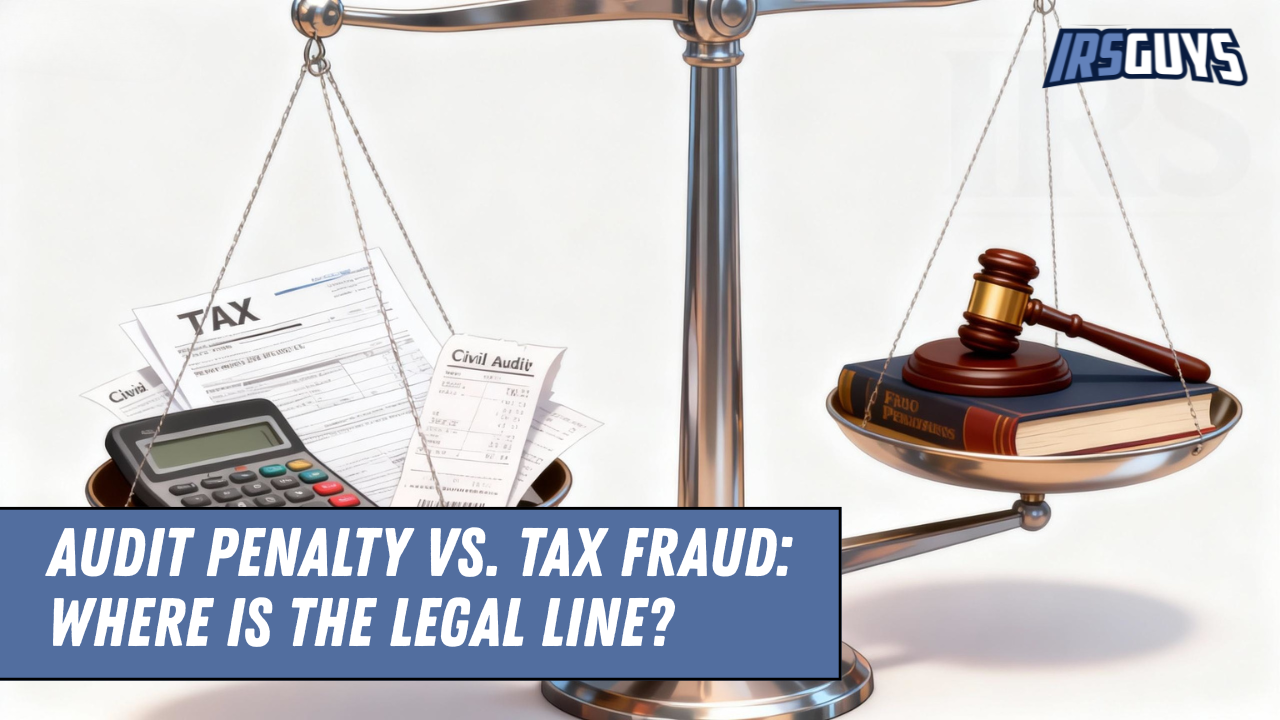
The IRS doesn’t treat every error the same. The key difference between a simple mistake and tax fraud is intent. Fraud happens when someone deliberately tries to avoid paying taxes they know they owe. Knowing where you stand in this system matters because the consequences can be severe. You could face a 20% civil penalty for negligence, a 75% penalty for fraud, with no time limit for enforcement, or even criminal charges that lead to fines and jail time.
The Civil Penalty (The 20% Risk)
The lowest tier of enforcement falls under the Accuracy-Related Penalty (Internal Revenue Code, IRC § 6662). This applies to failures in compliance that generally stem from carelessness or errors, not intentional deception.
The standard penalty rate is 20% of the underpayment. This penalty is usually triggered by two main circumstances:
- Negligence: This is defined as not making a reasonable attempt to comply with tax law or a failure to exercise ordinary business care and prudence. The IRS often establishes negligence simply by demonstrating a taxpayer’s failure to keep adequate books and records or properly substantiate deductions.
- Substantial Understatement: This is a purely mathematical trap that applies regardless of intent. For individuals, an understatement is considered substantial if the amount is the greater of $5,000 OR 10% of the tax required to be shown on the return. If you cross this numerical threshold, the 20% penalty applies unless you can successfully assert a defense.
Crossing the Line into Civil Fraud (The 75% Risk)
The jump from the 20% negligence penalty to the 75% civil fraud penalty (IRC § 6663) is where carelessness ends and deliberate malfeasance begins. The consequences are severe: if civil fraud is established, the normal three-year statute of limitations for assessments is eliminated, allowing the IRS to pursue collection indefinitely for that tax year.
To impose this substantial penalty, the IRS must prove fraud by a significantly higher standard: clear and convincing evidence. This means the government must demonstrate that the assertion of fraud is highly probable or reasonably certain.
The burden of proof is entirely on the government; a taxpayer does not have to prove their innocence. The key to proving civil fraud is establishing Willfulness (intentional wrongdoing with the specific purpose of evading a tax believed to be owing).
Proving the Lie: The “Badges of Fraud”
Since the IRS cannot read a taxpayer’s mind, they must rely on circumstantial evidence known as the “Badges of Fraud” to prove willful intent. These indicators show that a deliberate scheme was undertaken for the purpose of deceit or concealment.
Common Badges of Fraud include :
- Income Concealment: Omitting entire sources of income or unexplained substantial personal expenditures exceeding reported income.
- Record Irregularities: Maintaining multiple sets of books, making false entries, or intentionally destroying records after an audit begins.
- Obstructive Conduct: Making false statements to an examiner, failing to disclose material facts to a tax preparer, or actively concealing bank accounts or assets.
Courts will use a taxpayer’s background as an amplifying factor. For instance, the court can sustain fraud penalties partly because a taxpayer’s MBA and financial analysis background negates their claim of “honest misunderstanding” of basic tax principles, confirming the errors were intentional.
The Biggest Risk: Criminal Tax Evasion
The most severe outcome is criminal tax evasion (a felony), which carries penalties of substantial fines and up to five years in prison.
Under IRC § 7201, the government is required to prove your guilt with little to no room for doubt (the highest legal standard) to secure a conviction. This requires:
- A substantial tax due.
- Willfulness (a voluntary and intentional violation of a known legal duty).
- An Affirmative Act of evasion (e.g., filing a false return, concealing assets, or handling affairs to avoid keeping records).
Protecting Yourself
If you are facing an audit, your defense against all civil penalties, including fraud, is demonstrating reasonable cause and good faith. This is often proven by showing an honest misunderstanding of fact or law, or by demonstrating genuine reliance on the advice of a qualified tax professional to whom you provided all pertinent facts.
If a routine civil audit transitions to a criminal investigation (sometimes called an “Eggshell Audit”), the stakes become existential. You may notice red flags, such as the auditor suddenly going silent for weeks or focusing heavily on your motive or intent in taking a position.
If an IRS Special Agent (SA) approaches you, often identified by a badge and a gun, the civil matter has gone criminal. Your immediate action is paramount: you must demand that counsel be present and remain absolutely silent. Asserting your Fifth Amendment right to avoid self-incrimination is the only constitutional protection against providing the very evidence the government needs to prove willfulness and secure a conviction.
Bottom Line
The legal line is rooted in your intent. For taxpayers, vigilance, accurate record-keeping, and the proactive retention of expert legal counsel are your strongest defenses against crossing that perilous threshold.
IRS Guys: Your New Path to Tax Debt Relief
We are building a revolutionary platform of “plug-and-play” tools to help you resolve IRS debt. Gain the confidence to handle OICs, payment plans, and penalty abatements with automated resources that simplify your path to freedom.
BOOKMARK THIS PAGE SO YOU DON’T MISS THE LAUNCH!!